
Historical context
The historical evolution of boiler safety and pressure standards
In the early decades of industrial steam power, the absence of standardized manufacturing codes and safety testing led to catastrophic boiler explosions in mills, locomotives, and steamships. These recurring disasters prompted the founding of professional engineering bodies and the eventual publication of the landmark ASME Boiler and Pressure Vessel Code. The core lesson of this historical transition is unequivocal: every closed vessel containing heated water under pressure represents stored thermodynamic energy that must be governed by rigorous engineering calculations and mandatory safety margins.
Miniature steam boilers operate under the exact same thermodynamic physics as full-size industrial steam generators. While a miniature boiler holds a smaller volume of water, operating at elevated miniature pressures creates substantial internal forces against shell walls and end caps. Professional model engineering societies established comprehensive inspection codes requiring certified hydrostatic pressure testing, reliable safety valves, and calibrated pressure instrumentation.
The Science Museum Group preserves apprentice-built boiler models and testing apparatus, illustrating how workshop traditions instilled absolute respect for pressure vessel integrity. Apprentices were taught that safety is designed into the geometry, brazed joints, and operating discipline of a boiler, rather than added as an afterthought.
Modern model steam boilers constructed from seamless brass and copper tubes offer exceptional reliability and safety when operated within their certified parameters. Understanding how to inspect, pressure-test, and maintain these miniature pressure vessels allows operators to enjoy live steam with complete peace of mind.
The documented history of miniature engineering reveals that safe operating habits are established on the test bench. Verifying that safety relief pathways vent freely, testing pressure gauges against master reference instruments, and maintaining disciplined water management protocols transform pressure vessels from potential hazards into dependable thermal generators.
Engineering principle
Hoop stress calculation, silver soldering, and hydrostatic physics
The structural integrity of a cylindrical boiler barrel is evaluated using Barlow’s formula for hoop stress: tensile stress in the cylinder wall equals internal pressure multiplied by outer diameter, divided by twice the wall thickness. For quality miniature boilers, wall thicknesses are selected with large safety factors—often six to eight times the maximum working pressure—ensuring that normal operating stresses remain well below the elastic limit of the brass or copper alloy.
Joining techniques represent the critical structural barrier against pressure failure. Miniature steam boilers must be assembled using high-temperature silver brazing (silver soldering) with alloys containing 40% to 55% silver, which melt between 620°C and 680°C. Soft solders based on lead or tin melt at temperatures as low as 180°C and are strictly prohibited on pressure vessels, as an accidental low-water condition would melt soft solder instantly, causing catastrophic shell rupture.
Hydrostatic pressure testing is the universal gold standard for verifying boiler safety because water is virtually incompressible. During a hydrostatic test, the boiler is filled completely with room-temperature water and pressurized using a hydraulic test pump to 1.5 to 2 times the designed working pressure. If a structural defect or seam failure exists, the minute volume expansion causes pressure to drop to zero instantaneously without an explosive release of energy.
Pneumatic testing with compressed air or gas is strictly forbidden on uncertified boilers. Compressible gases store vast amounts of explosive kinetic energy under pressure; if a shell fractures during pneumatic testing, the gas expands violently, producing hazardous shrapnel.
Design trade-offs
Thermal conductivity, metallurgy, and wall thickness trade-offs
Designing a miniature boiler involves balancing thermal heat transfer against mechanical structural strength. Copper boasts exceptional thermal conductivity, allowing heat from burner flames to pass rapidly into the water mass. However, copper anneals and softens when heated, requiring adequate wall thickness and structural stay rods across large flat surfaces like end caps.
Brass alloys offer greater structural rigidity and machineability for threaded bush fittings, safety-valve bodies, and water-gauge mountings. However, brass has lower thermal conductivity than pure copper and requires careful silver-brazing temperature control to avoid zinc burning. High-quality model boilers frequently combine seamless copper barrels and fire tubes with heavy cast brass end caps and bronze threaded fittings.
Wall thickness decisions also incorporate a long-term corrosion allowance. Over years of steaming, chemical reactions and mineral deposits can slowly erode interior metal surfaces. Designing boiler shells with generous metal thickness guarantees that even after decades of service, the vessel retains ample wall thickness to resist working pressures safely.
Internal fire tubes and flue passages increase the effective heating surface area, enabling a compact boiler to produce steam rapidly. However, adding internal tubes increases the number of brazed joint seams that must be inspected and maintained throughout the life of the boiler.
Collector's perspective
Collector’s care: inspecting brasswork, fittings, and scale prevention
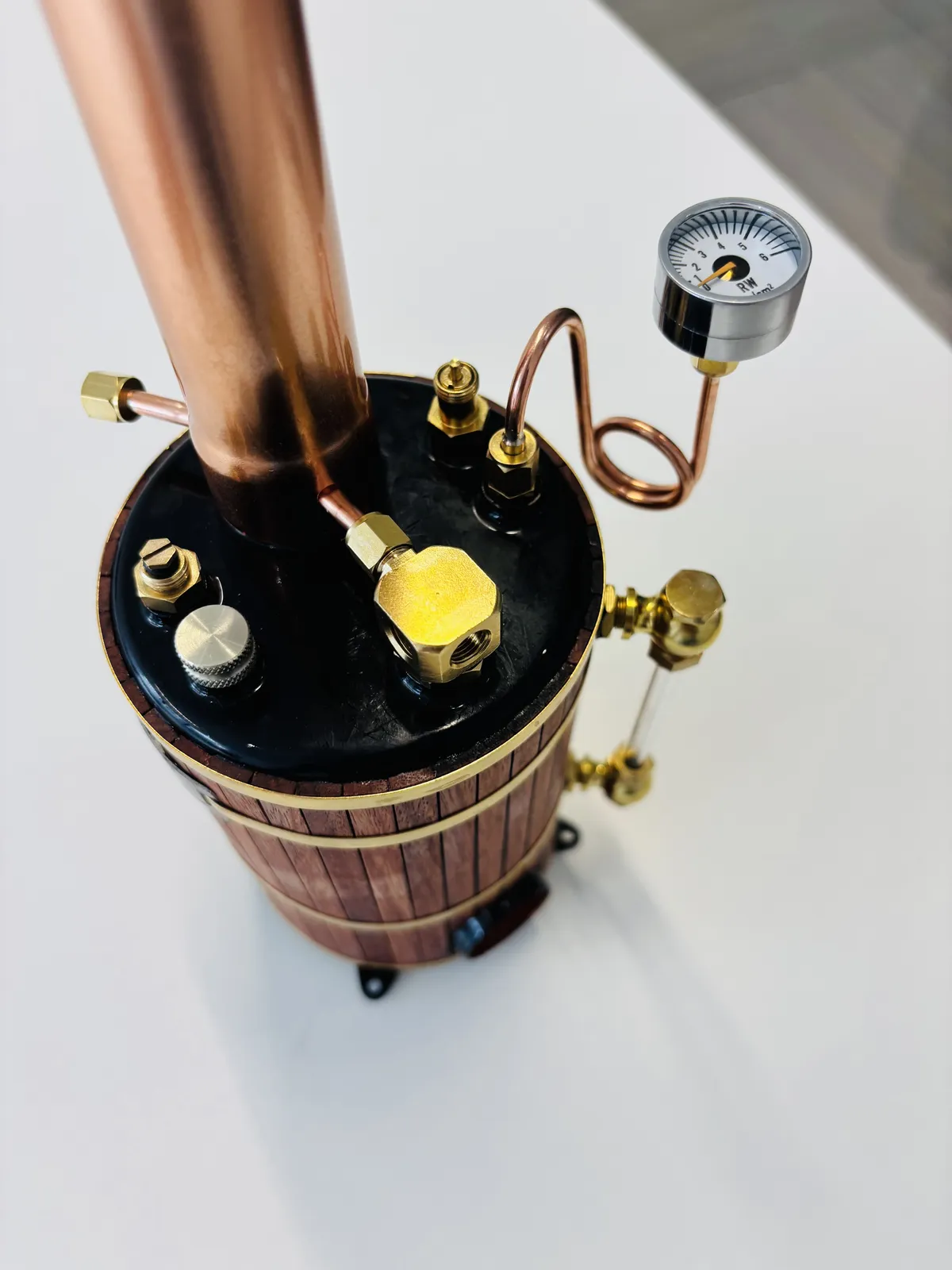
A finely built miniature brass boiler is a visual centerpiece of any engineering collection. The warm golden glow of polished brass fittings, combined with delicate glass water-level gauges and miniature pressure dials, evokes the craftsmanship of Victorian scientific apparatus.
Collectors should inspect silver-brazed joints with a magnifying loupe, looking for smooth, continuous fillets of silver alloy around every tube and bushing. Safety valve spindles should be tested by hand before every display or firing session to confirm that the spring-loaded valve lifts cleanly from its seat without sticking or binding.
Water quality management is essential for preserving internal boiler surfaces. Never use mineral-rich tap water, which deposits calcium carbonate scale on internal heating surfaces, acting as a thermal insulator and causing localized metal overheating. Always use pure distilled or demineralized water to keep boiler interiors pristine and scale-free.
Documented implementation
Boiler engineering on the documented Rocking Whale BL1K set
Rocking Whale documents the BL1K as a complete single-cylinder steam engine and boiler set built with heavy brass fittings and copper pipework. The integrated boiler features a documented 200 ml water capacity, 650 g boiler weight, and a normal working pressure of 2 kg/cm².
The documented BL1K safety circuit includes an adjustable spring-loaded safety valve calibrated to release at 2.5–3 kg/cm², a high-visibility pressure gauge with a 0–7 bar display range, and an alcohol fuel burner engineered for controlled thermal input.
Operational practice
Hydrostatic test protocol, safety valve checks, and water management
Conducting a formal workshop hydrostatic test requires a simple hand-operated hydraulic pump, a calibrated master pressure gauge, and clean water. Remove the safety valve, fill the boiler 100% full with water to purge all air bubbles, and seal the filler plug. Slowly pump water until the gauge reads 1.5 times the rated working pressure and hold the pressure for 15 minutes while inspecting all seams for weeping.
Verify safety valve operation by gently lifting the knurled valve cap to ensure the internal spring and stainless ball or cone move freely. Under steam, the valve must lift automatically and vent excess steam briskly when boiler pressure reaches the calibrated blow-off limit, preventing any further pressure climb.
Before firing, fill the boiler with distilled water to approximately 70% to 80% of total capacity—never fill completely to 100%, as adequate steam space above the water line is necessary to prevent priming (water carryover into the engine). Never fire a boiler without confirming water presence, and immediately extinguish the burner when water falls to the minimum level.
Documented figures
Model-specific specifications.
| Specification | Documented value |
|---|---|
| Boiler capacity | 200 ml |
| Boiler weight | 650 g |
| Boiler working pressure | 2 kg/cm² |
| Safety-valve pressure | 2.5–3 kg/cm² |
| Pressure gauge range | 0–7 bar |
Editorial sources
References & further reading
- Newcomen Engine and the Origins of Pressure Vessel Safety American Society of Mechanical Engineers Open source
- Model beam engine and apprentice workshop pressure equipment Science Museum Group Collection Open source
Engineering tools & resources
Comparing engine configurations? Explore the Model Steam Engine Comparison Guide. Evaluating hull propulsion? Use the interactive Model Boat Steam Engine Size Calculator.