Historical context
Two cylinders answered practical packaging questions
Multi-cylinder arrangements developed within particular duties rather than as a single, linear replacement for one-cylinder engines. ASME’s record of the 1873 TV Emery Rice engine describes a horizontal compound marine engine whose arrangement placed two cranks near its cylinders and used paired, off-centre piston rods around the crankshaft. Its context was the nineteenth-century transition to screw-propelled ships, where machinery had to fit within a constrained hull.
Two-cylinder marine engines could also pursue reduction of size and weight through other geometry. ASME identifies the 1841 John Penn oscillating engine on the paddle steamer Diesbar as a two-cylinder design whose oscillating cylinders used fewer parts than other engines of its era. That example cautions against treating “twin cylinder” as one mechanism: cylinder count, orientation, valve arrangement and intended duty all matter.
For modern model work, the historical lesson is practical. A twin should be assessed as a complete assembly of two steam circuits, a crankshaft, bearings, valve gear and mounting surfaces. More cylinders can offer additional torque events, but they also make timing, pipework, lubrication and service access more interdependent.
This is why multi-cylinder history should be read as a history of engineering constraints, not as a sequence of decorative cylinder counts. Marine machinery needed power within a hull and a usable shaft arrangement; stationary machinery could give different weight to foundation, governor response, belt drive and access. In each case, a second cylinder changed the relationship between the moving parts and the steam circuit rather than merely duplicating the first.
Engineering principle
Crank phasing creates overlapping turning effort
A twin-cylinder engine places its crank throws at a deliberate phase angle. As one piston approaches a position of weak turning leverage, the other can be at a more effective crank angle. This makes a suitable starting position more likely and reduces the depth of the torque troughs compared with one cylinder; it does not make torque perfectly constant.
Phasing also changes the pressure-flow demand seen by the boiler. Overlapped admission events can make the engine draw steam more continuously, while exhaust and receiver arrangements influence back pressure. Smooth running therefore depends on valve events, load, boiler pressure and steam passages as well as cylinder count.
Torque overlap is a useful description, provided it is not overstated. With favourable phasing, one cylinder can contribute turning effort while the other moves through a less advantageous angle. The combined torque curve is therefore often less deeply interrupted than that of a single cylinder. The exact curve remains dependent on the crank angle, piston forces, valve events, expansion, exhaust conditions and the inertia of the rotating parts.
Steam flow is likewise a system question. Two cylinders may ask for steam at different points in the revolution, and their combined admission may make demand appear more even at the boiler outlet. Pipe diameter, throttling, steam-chest passages, condensation and back pressure all influence what reaches the cylinders. A twin cannot be judged from its cylinder count alone, because a restrictive or poorly drained steam path can dominate the result.
Engineering principle
What cylinder count does—and does not—establish
Two cylinders provide two separate reciprocating mechanisms and more frequent torque impulses per revolution. Their practical benefit comes from the complete arrangement: crank phase, valve timing, bearing support, flywheel inertia, lubrication, steam supply and alignment all remain consequential.
This article describes twin-cylinder engineering at configuration level. It intentionally does not assign displacement, pressure, speed, torque, power, boiler capacity or other numerical characteristics to models for which those values are not documented in the current Rocking Whale manuals.
Balance also deserves careful language. Reciprocating parts accelerate and decelerate on every revolution, so a twin can exchange some inertia forces and moments without becoming inherently free of vibration. Crankshaft counterweights, rod geometry, frame stiffness, bearing condition and the connected load all influence what is felt at the mounting points. A model installation adds its own structure: a flexible base can make an otherwise orderly mechanism appear rough.
Design trade-offs
Twin-cylinder trade-offs: continuity brings coordination
A twin offers more opportunities for useful turning effort and can make starting less dependent on a single crank position. For a model engineer, that can be valuable where a connected shaft or propeller imposes a persistent load. The gain is achieved by coordinating two mechanisms, not by bypassing the need for proper valve timing, lubricated bearings and an adequate steam supply.
The added coordination has costs. There are more piston, rod, valve and joint interfaces to inspect, and the steam distribution must reach both cylinders without creating an avoidable imbalance. A compact installation may make external piping short, but it can also make access to unions, drains and oil points less convenient. The preferred arrangement depends on the space available and on whether the priority is visibility, service access or a small footprint.
This generic twin discussion deliberately separates layout principles from any particular model. A specified pressure range, speed limit, output figure or construction detail belongs to its source manual and should never be inferred from the fact that an engine has two cylinders.
Collector's perspective
Collector’s perspective: the rhythm of a phased mechanism
The appeal of a twin is not simply that two pistons move instead of one. It is possible to watch the phase relationship travel through the crankshaft: one rod approaches a change of direction while the other occupies a different part of its stroke. At moderate running speed this is a concise visual lesson in how crank arrangement shapes the delivery of motion.
A careful observer can compare the action of the two valve trains, the symmetry or intentional asymmetry of the steam passages, and the support given to the shaft. Those details tell more about the character of an individual engine than an assumption that every twin must have the same balance or exhaust note. They also provide useful inspection points before a live-steam run.
For display and preservation, avoid using high speed as the primary evidence of quality. Smoothness should be considered together with mounting rigidity, lubrication, valve response and the absence of binding. A twin that turns freely and responds consistently at a controlled setting demonstrates its mechanism more clearly than one run beyond the conditions in which its owner can inspect it.
The twin also invites comparison with the single-cylinder layout without reducing either to a verdict. The observer can see why an additional phase may improve the continuity of turning effort, then notice the extra rods, valves and steam connections that make the assembly more demanding to set up. That balance of gain and responsibility is the most useful collecting lesson the configuration offers.
Documented implementation
A documented V2 example, kept distinct from the general theory
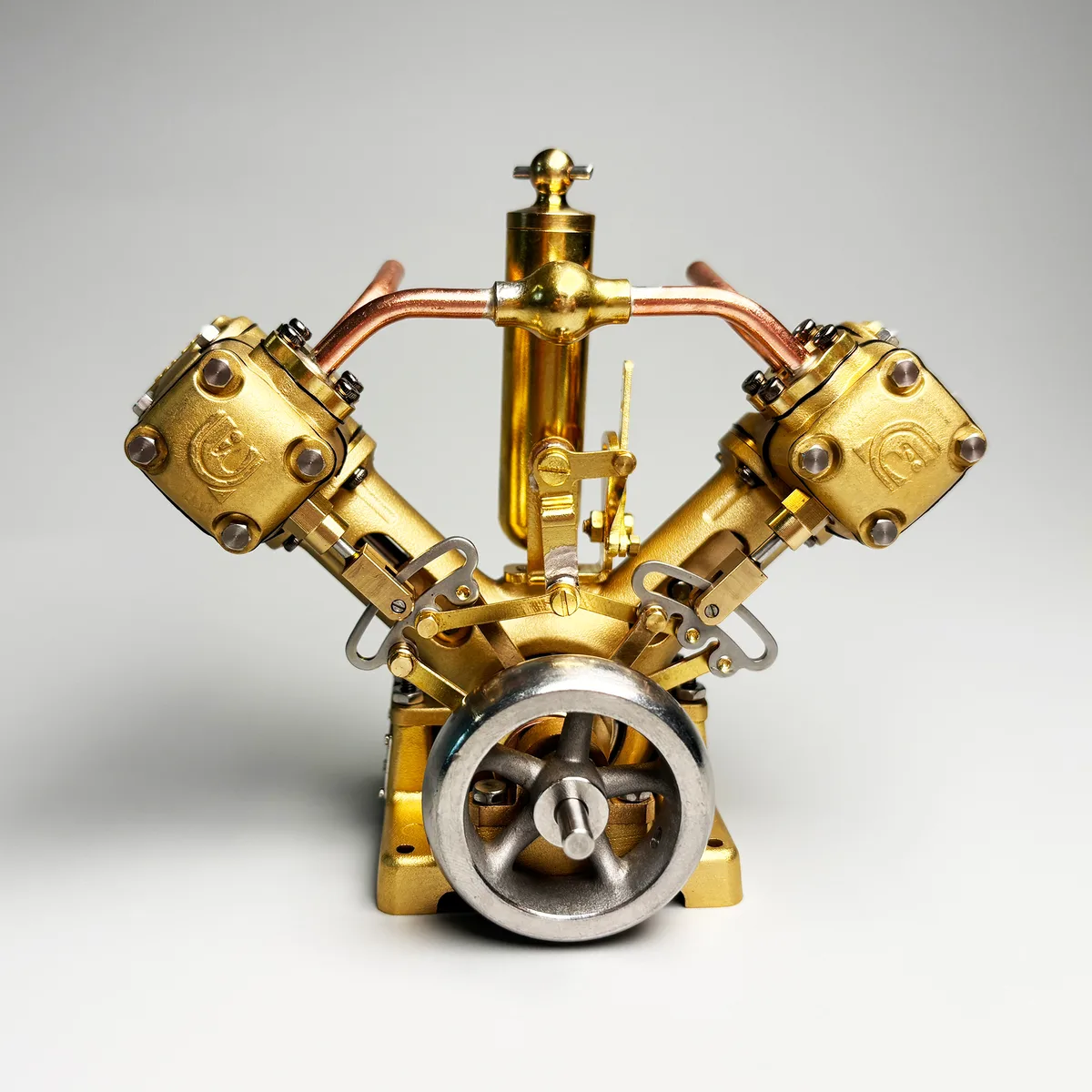
Rocking Whale documents the V2 as a 90-degree twin-cylinder engine with a die-cast brass structure, stainless-steel cylinder liners, composite piston rings, a ball-bearing-supported crankshaft and complete Stephenson valve gear for forward and reverse. This is a documented example of one twin arrangement, not a claim that these construction details define every twin-cylinder steam engine.
The V2/L2 manual further directs the installer to use a flat mounting plate and maintain concentric alignment between the driven shaft and the crankshaft. Its oiling, running-in and reversing instructions are model-specific operating guidance, while the phasing discussion elsewhere in this article remains configuration-level engineering theory.
Operational practice
Operating implications
Starting quality should be assessed with the installed load and its shafting, not by free-running speed alone. A correctly concentric drive line limits side load on bearings and helps preserve the designed valve and crank geometry. Reversing gear should be changed only after speed has been reduced, because a sudden reversal of the valve events at high speed can impose a severe transient load.
Editorial sources
References & further reading
- TV Emery Rice Steam Engine American Society of Mechanical Engineers Open source
- Oscillating Steam Engine American Society of Mechanical Engineers Open source
Engineering tools & resources
Comparing engine configurations? Explore the Model Steam Engine Comparison Guide. Evaluating hull propulsion? Use the interactive Model Boat Steam Engine Size Calculator.