
Historical context
Marine steam propulsion and scale hull dynamics
The application of steam power to small watercraft—from Victorian river launches and naval pinnaces to harbor workboats—established fundamental principles of marine architecture that remain vital in radio-controlled model engineering. ASME documents the historical transition toward compact multi-cylinder marine engines designed to sit low in the hull, direct-driving the propeller shaft while providing immediate reversing capability without clutches or reduction gearboxes.
In scale naval architecture, hull behavior is governed by Froude scaling laws. Scale steam launches are displacement vessels whose maximum practical speed is limited by waterline length. Attempting to overpower a displacement hull with excessive horsepower does not produce proportional speed increases; instead, it generates excessive bow waves, stern squatting, and severe boiler steam depletion.
The Science Museum Group preserves working models of vertical marine steam plants, demonstrating how historic designers coordinated engine displacement, boiler evaporative surface area, fuel capacity, and propeller pitch into a harmonious propulsion package. A successful scale steam launch relies on balanced systems engineering rather than raw engine size alone.
For the model builder, selecting the proper engine layout—single-cylinder, compact twin, inline twin, or multi-cylinder four-cylinder configurations—dictates not only scale performance on the water but also internal hull layout, center of gravity, and operational endurance during lake-side runs.
Historical model engineering records illustrate that early twentieth-century marine modelers spent considerable time testing different hull lines in towing tanks to identify optimal shaft lines and displacement forms. Preserving these naval architecture principles in modern working scale craft bridges the gap between static scale modeling and genuine motive-power engineering.
Engineering principle
Hull speed calculations, torque curves, and propeller matching
Matching a live-steam engine to a model hull begins with the theoretical hull speed formula: maximum displacement speed in knots equals approximately 1.34 times the square root of the waterline length in feet. For a 100 cm (approximately 3.3 ft) model launch, the theoretical hull speed is roughly 2.4 knots. Driving the hull beyond this threshold requires exponential power increases that outstrip miniature boiler capacities.
Steam engines deliver maximum torque at zero and low RPM, making them fundamentally different from high-revving electric motors or glow-plug internal combustion engines. This high low-speed torque allows live-steam engines to turn large-diameter, coarse-pitch scale brass propellers directly, delivering realistic thrust and a gentle, majestic wake without propeller cavitation.
Propeller diameter should generally measure between 40% and 60% of the hull draft at the stern post. A twin-cylinder engine delivering moderate torque output comfortably swings a three- or four-blade brass propeller of 45 mm to 55 mm diameter, whereas a multi-cylinder engine with generous scale torque can effortlessly turn heavy scale propellers of 60 mm to 75 mm diameter on hulls over one meter in length.
Continuous steam consumption must match the boiler steaming rate. If an engine consumes more volume of steam per revolution than the boiler burner can evaporate at working pressure, boiler pressure will drop steadily during running, leading to engine stalling mid-pond. Matching engine displacement to boiler capacity ensures steady pressure equilibrium throughout a 15- to 20-minute run.
Design trade-offs
Center of gravity, weight distribution, and hull packaging
Installing a live-steam plant inside a model boat hull requires careful management of mass distribution and center of gravity. A complete steam plant comprises multiple dense components: engine block, boiler vessel filled with water, gas or alcohol burner tank, displacement lubricator, and radio-control servo gear. Placing these heavy items too high above the waterline creates an unstable, top-heavy craft prone to excessive rolling.
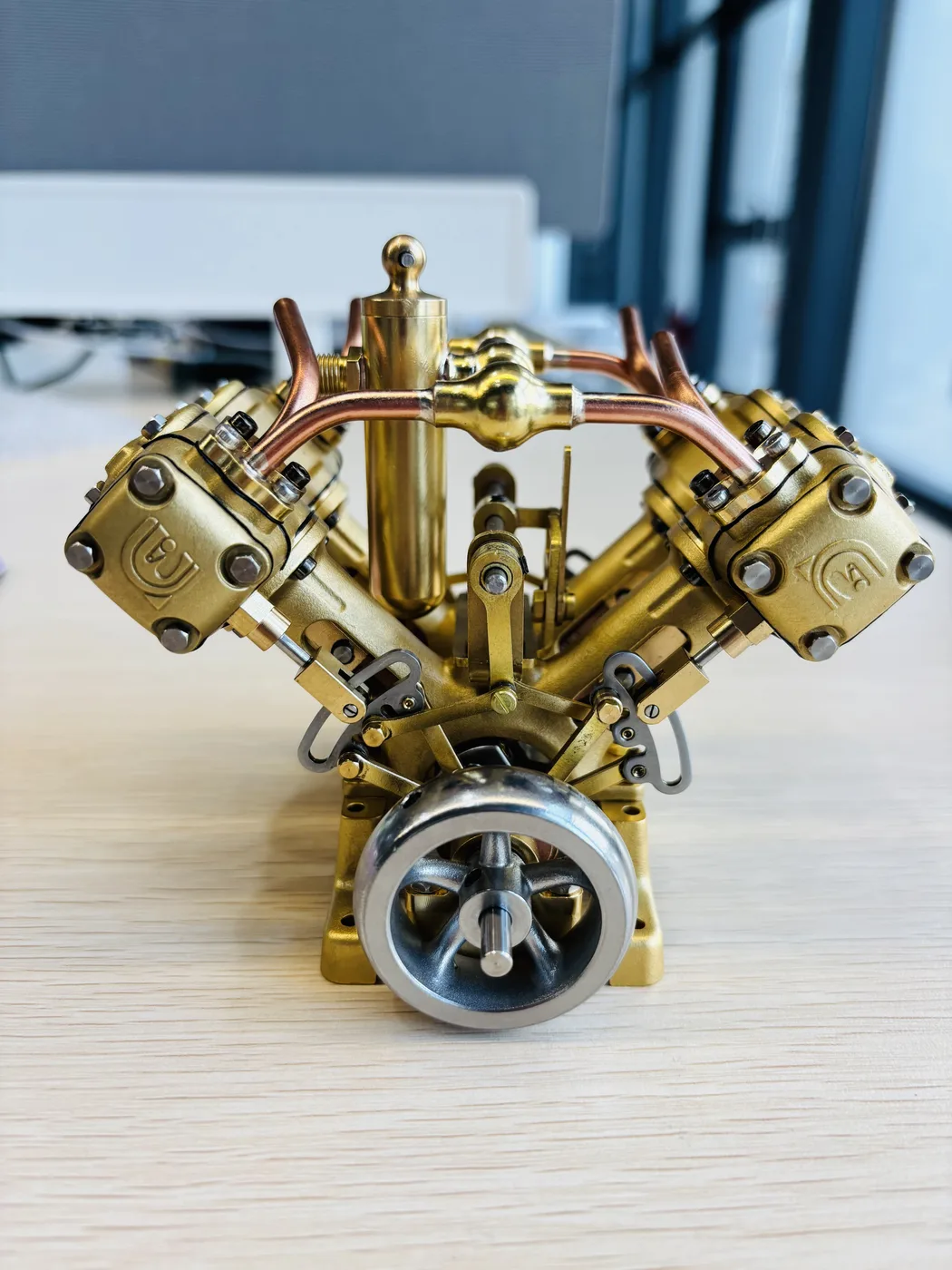
A compact 90° V-engine or low-profile multi-cylinder arrangement packages substantial displacement and torque within a low vertical envelope, allowing the crankshaft to align naturally with a shallow propeller shaft angle. An inline twin engine offers a long, slender footprint that suits narrow-beam cruising launches but requires adequate fore-and-aft cabin length.
Boiler placement must balance the fore-and-aft trim of the vessel. The boiler and its water payload should ideally sit directly over the hull center of buoyancy so that as water evaporates during the run, the boat maintains a level trim without excessive bow-up or stern-down attitude.
Thermal isolation is another critical trade-off. Boilers and exhaust lines radiate significant heat inside an enclosed hull. Builders must line wooden or fiberglass hull frames with ceramic heat shielding, provide natural ventilation louvers or cowls, and isolate delicate radio receivers and lithium batteries from high-temperature zones.
Collector's perspective
The collector and builder perspective: live steam on open water
Few experiences in scale modeling equal the sight and sound of a live-steam launch operating on open water. The rhythmic chuff of the exhaust, the visible wisp of white steam curling from the brass funnel, and the gentle churning of a scale brass propeller create an authentic sensory experience that static displays and electric models cannot replicate.
On the water, the instantaneous reversing capability of link motion gives the skipper absolute confidence when maneuvering around docks or navigating pond hazards. Shifting the radio control reversing lever produces an immediate, smooth reversal of propeller direction without gear grinding or electrical delay.
Crafting a dedicated transport cradle and lake-side tool kit enhances the operational ritual. Preparing water, lighting the burner, raising steam pressure, and setting sail becomes a collaborative, contemplative hobby that connects the modeler directly with the golden age of marine engineering.
Scale fidelity on the water extends beyond speed alone to encompass the overall attitude of the vessel as it cuts through calm ripples. A properly trimmed live-steam craft creates realistic bow waves and a gentle wake that looks convincing from the shoreline.
Documented implementation
Multi-cylinder marine capability of the documented Rocking Whale V4
Rocking Whale documents the V4 as a flagship four-cylinder model steam engine engineered for substantial marine installations and large model boats. The manufacturer specifies selection guidance for hull lengths ranging from 90 cm to 150 cm, where multi-cylinder torque continuity and smooth power delivery are paramount.
The V4 is documented with an operating speed of 2800 RPM, 2000 gf·cm maximum torque, and a normal working-pressure range of 0.5–2 bar with a 3 bar maximum limit. Its coordinated four-cylinder architecture provides smooth low-RPM direct drive and ample reserve thrust for large scale hulls.
Operational practice
Installation alignment, RC linkage integration, and lake-side checks
When mounting the engine in a hull, concentric alignment between the engine output shaft and the propeller stuffing box is vital. Use a flexible double-universal coupling or dog-drive coupling to absorb minor hull flexing, and install a dedicated ball thrust bearing on the propeller shaft to prevent hydrodynamic thrust forces from pushing directly against the engine crankshaft bearings.
Connect standard radio-control servos to the steam regulator valve and the Stephenson reversing arm using rigid pushrods and ball links. Set servo end-point travels carefully on your transmitter to ensure full valve opening and complete quadrant travel without causing servo stalling or excessive linkage strain at mechanical stops.
Before launching on open water, perform a complete dry test on the lake bank. Verify boiler water level at 75% capacity, check burner fuel supply, test radio control range with the burner operating, and confirm that the displacement lubricator is filled with compounded steam oil. Always sail with the wind initially so that in the event of an unexpected burner flame-out, the boat gently drifts back toward shore.
Documented figures
Model-specific specifications.
| Specification | Documented value |
|---|---|
| Configuration | V4-cylinder |
| Speed | 2800 RPM |
| Max. torque | 2000 gf·cm |
| Normal working pressure | 0.5–2 bar |
| Maximum working pressure | 3 bar |
Editorial sources
References & further reading
- Marine Steam Propulsion and Small Craft Architecture American Society of Mechanical Engineers Open source
- Working model triple expansion vertical marine steam engine Science Museum Group Collection Open source
Engineering tools & resources
Comparing engine configurations? Explore the Model Steam Engine Comparison Guide. Evaluating hull propulsion? Use the interactive Model Boat Steam Engine Size Calculator.