Historical context
More cylinders, more coordinated mechanism
As steam power served ships, mills and generating stations, designers used more complex arrangements to address efficiency, space and power-transmission requirements. ASME’s account of a marine-type triple-expansion engine adapted to drive dynamos describes compact marine practice being applied to stationary electrical generation. The specific thermodynamic role of expansion stages in that machine differs from a simple four-cylinder V arrangement, but it shows why “more cylinders” has historically meant more coordination rather than only more output.
The Science Museum Group records a working model of an inverted vertical triple-expansion engine, describing three cylinders in sequence and a low crankshaft suitable for direct propeller-shaft coupling. That direct record illustrates how a model can preserve the coordination of a multi-cylinder mechanism without making a compact four-cylinder V engine a copy of the historical engine. Cylinder number, bank angle, crankshaft arrangement, valve gear and steam circuit must be examined together.
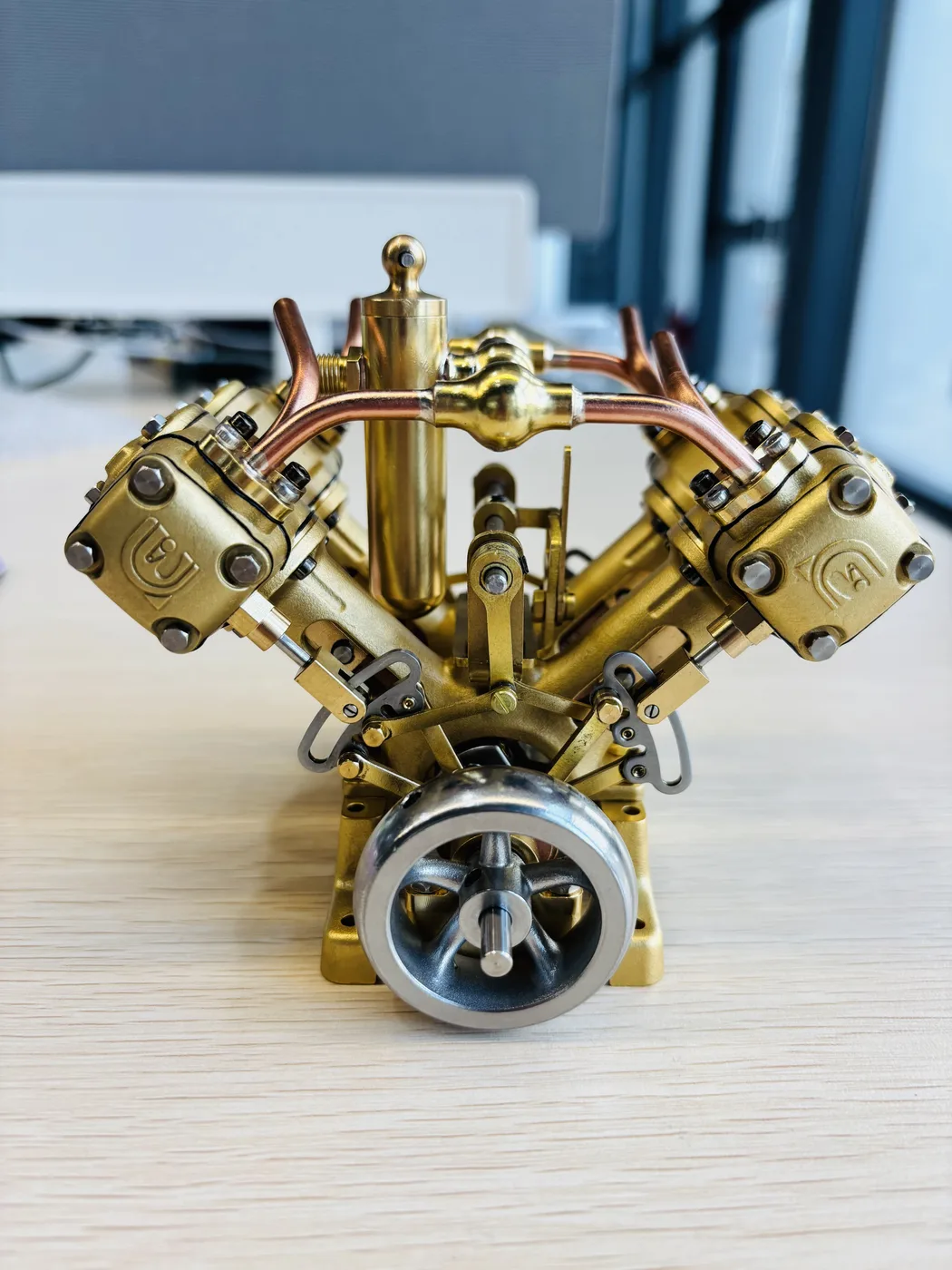
A four-cylinder V model carries this systems lesson in a compact form. Its interest lies in the visible coordination of several rods, cranks and valve settings around a common output. The collector or operator should look for consistent movement across the banks and for orderly access to lubrication and reversing linkage, rather than assuming smoothness solely from cylinder count.
The historical comparison is deliberately limited. A triple-expansion engine distributes steam through stages of different pressure, whereas a four-cylinder model may use its cylinders in a different steam circuit entirely. What the examples have in common is the need to coordinate several moving units with one output shaft. Multi-cylinder machinery has always made the relationships between space, valve gear, shaft support and service access more consequential.
Engineering principle
Four cylinders reduce the interval between torque events
A four-cylinder V engine groups four cylinders around a common crankshaft in two banks. With suitable crank and valve phasing, more cylinders place useful expansion strokes around the revolution more frequently. The result is a smaller torque fluctuation than a comparable single or twin arrangement, although steam pressure, timing, friction and load still determine the measured smoothness.
A compact multi-cylinder engine is a system of coupled adjustments. Reversing both banks consistently requires linkage geometry that carries the same valve-setting command to each side, while shaft support must control the loads imposed by the additional rods and valve gear.
Torque regularity should be described as a tendency, not a guarantee. Four expansion events can be distributed more frequently around a revolution when the crank and valve timing support it. The resulting torque pattern may be less pulsating than that of a single or twin layout, but it remains affected by steam pressure, throttling, exhaust conditions, mechanical friction, inertia and the load connected to the shaft.
Bank coordination is the central mechanical question in this layout. Each bank contains its own reciprocating parts, yet both must contribute through a common crankshaft and respond appropriately when valve settings are changed. A reversing linkage is therefore not a decorative cross-shaft: it must transmit a controlled movement to the valve gear without lost motion or interference. The exact linkage form belongs to the individual engine design.
Design trade-offs
V4 trade-offs: regularity requires a denser system
The attraction of a compact high-cylinder-count engine is understandable. More cylinders can provide more closely spaced torque events and a visually rich mechanism within a modest footprint. This can suit a model installation where smooth shaft delivery and an impressive exposed engine are both priorities. It does not eliminate the need to match boiler capacity, steam passages and load to the actual engine.
The trade-off is a denser set of moving and adjustable parts. Four cylinders bring more rods, pistons, valve events, lubrication points and potential sources of friction. Bank coordination makes the reverse setting and its linkage especially important, while a compact frame can make inspection less direct than on an open inline arrangement. Careful assembly and adjustment become more, rather than less, valuable as cylinder count increases.
A high cylinder count also changes the service question. An operator must be able to see whether all banks receive appropriate lubrication, move freely and respond together before a demanding run. The best use of compactness is not to crowd every connection into the smallest possible space, but to leave enough room for the output coupling, steam and exhaust lines, fasteners and routine maintenance.
The connected plant must be considered with equal care. A four-cylinder V configuration can make shaft motion appear more even, yet a restrictive steam path, a poorly aligned coupling or a load that changes abruptly can still dominate its behaviour. The engineer should first establish free, lubricated motion and a sound installation, then make gradual changes to steam admission and load while observing whether all banks remain coordinated.
This is the proper trade-off behind compact high-cylinder engineering: greater mechanical continuity is earned by greater responsibility for adjustment and inspection. The arrangement is most successful when each bank can be checked as part of a coherent plant, rather than when the extra mechanism is treated as a reason to overlook basic installation discipline.
When selecting this arrangement, favour a display or installation that lets the mechanism remain intelligible. The engine’s distinctive value comes from seeing several coordinated systems work together; hiding its service points or loading its shaft carelessly defeats the purpose of the compact multi-cylinder layout.
Collector's perspective
Collector’s perspective: coordinated motion as the subject
This configuration repays close inspection because its interest lies in coordination rather than in any single large moving part. Watch one bank through a revolution, then compare its rod travel and valve response with the other bank. The visual sequence turns abstract phrases such as multi-cylinder torque regularity and bank coordination into something that can be observed directly.
The most informative details are the interfaces: the common crankshaft, the supports that locate it, the connection between banks and the reversing linkage that changes valve events together. Good workmanship is visible in clear motion, secure fasteners, accessible oiling and mechanisms that do not clash through their range. These observations are more meaningful than assuming that four cylinders are automatically quiet or effortless.
For display, leave enough sightlines to understand the compact high-cylinder layout. For preservation, avoid treating the denser mechanism as inaccessible ornament. A disciplined routine of inspection, appropriate lubrication, cleaning after operation and gentle handling of controls protects both the visual character and the working integrity that distinguish a live-steam model.
Documented implementation
The documented Rocking Whale V4
Rocking Whale documents the V4 as a compact four-cylinder engine whose four cylinders are arranged in a small space. The manual specifies coaxial linkage for the reversing mechanism of the two cylinder rows, CNC rocker arms and copper-sleeve bearing support on the reversing shaft. It also records a die-cast brass structure, stainless-steel cylinder liners, composite piston rings, ball-bearing crankshaft support and complete Stephenson reversing gear.
The V4 is documented at 12 cc displacement, 2800 RPM, 2000 gf·cm maximum torque and 0.05 HP. Its normal working-pressure range is 0.5–2 bar, and the manual sets 3 bar as the maximum engine working pressure.
Operational practice
Installation and disciplined operation
Mount the V4 on a flat wood or metal plate and align the driven shaft concentrically with the engine shaft. Before running, drain any accumulated water from the oil tank, refill it with steam oil and lubricate the listed moving parts. The manual specifies approximately one hour of running-in below 2000 RPM, followed by a check of fasteners.
Reduce engine speed before operating the reverse gear; if a shift is difficult, temporarily close the regulator as the manual directs. Avoid no-load overspeed. Although the rated specification lists 2800 RPM, the documented maximum working speed is 3000 RPM. Check wearing parts at the prescribed service intervals, and allow the engine to cool before contact.
Documented figures
Model-specific specifications.
| Specification | Documented value |
|---|---|
| Configuration | V4-cylinder |
| Displacement | 12 cc (1.5 cc × 2 × 4) |
| Speed | 2800 RPM |
| Maximum torque | 2000 gf·cm |
| Power | 0.05 HP |
| Normal working pressure | 0.5–2 bar |
| Maximum working pressure | 3 bar |
Editorial sources
References & further reading
- Marine-type Triple-expansion, Engine-driven Dynamo American Society of Mechanical Engineers Open source
- Working model triple expansion vertical steam engine and storage box Science Museum Group Collection Open source
Engineering tools & resources
Comparing engine configurations? Explore the Model Steam Engine Comparison Guide. Evaluating hull propulsion? Use the interactive Model Boat Steam Engine Size Calculator.